Showing posts with label eating well. Show all posts

Monday, 15 August 2016

Is it raining with you?

This is the lower pond where Ian removed the drainage
channel and blocked the exit. We are not sure if that did the
trick or it is just all the rain we have had, but it sure is filling
up fast now. We were also excited to see the fish swimming
around in it today. We haven't seem them since they were
put in just before all the water receded and left them just a
small area - deep, but small. It seems like they have
survived well and grown quite a bit in the process.
It sure is raining here on a frequent basis. We've had some sunny spells but a lot of rain. The ponds are full, the road is a mess and plants are struggling with the damp conditions - so is Ian. Ian does not like the rain, I'm from the soggier side of Britain and used to frequent trips up to the even damper Lake District as a child and so I don't mind so much, but even I would like to see a spell of dry weather again, maybe not as long as the last time, but still is a week too much to ask for? Every time it rains I have one of two songs going through my head and for those who recognise the lyrics from the title, one of them is Annie Lennox's "Here comes the rain again" or alternatively Supertramps "It's raining again." I think I'm getting a little tired of those earworms.
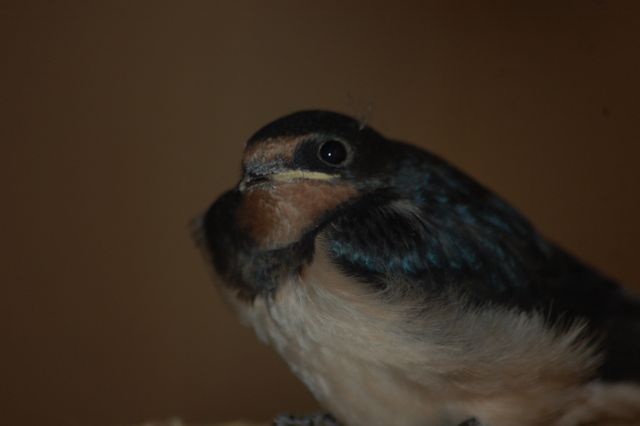
The baby swallows have all grown up now and left their nest.
They are still roosting in the girls' alpaca house at the moment
though, but we are not sure for how much longer before they
take off to sunnier climes. It was amusing to see them all hovering
around inside this evening as we treated some itchy patches on
Agnese's nose. Five young swallows all making a noise
because we were in there.

Today's collection of mushrooms from our forest in the
bucket. Some advantages to the damp days anyway
Some of our potatoes are showing signs of blight due to the soggy weather and it is a dilemma as to whether to dig them up yet, but it might be still early when we need to store them over winter and besides, did I tell you? It's raining again! That of course makes it difficult to dig them up. Mind you, the ones we have dug and are free of blight have been lovely. We are finally getting an assortment of vegetables and we were even able to offer some vegetarians an evening meal just using the vegetables from the garden and not feel like apologising for the lack of variety. Since we only have a halogen oven, one hob and a slow cooker I settled on a vegetable stir fry and baked potatoes. So we had peas, cauliflower, carrots with some carrot leaves, lovage, marjoram, sage, nettles and hollyhock leaves. Today we had wild boar pie, carrots, peas, onions and mushrooms in a white sauce and baked potatoes. Rather tasty too, if I do say so myself.
We emptied the water out of the well to see if it would fill up
again - it did! We could see the water level rising immediately
after we emptied it, so that was encouraging. We are still waiting
to hear whether the guy is going to help us dig the well, as Ian
is still not quite sure how to go about it yet. Still if the
worse comes to the worse, he can have a go himself. At least
we know there is water there.

Mari drinking deep
This week I went to some church meetings. We haven't done that in a long time, as the nearest churches are quite far and we are quite comfortable not attending meetings. We haven't given up meeting with people of faith and wouldn't want to, but our rich heritage from our previous churches has more than sustained us over time. I went primarily to connect with some folks who we haven't had the chance to meet for a while and also to hear the main speaker who was Terry Virgo. I'm not a fan of big meetings and definitely wouldn't traipse half way across the country to listen to some big speaker, as I know that God is quite capable of speaking through people without special titles as much as those who are held up as leaders in the faith. However, it did amuse me that a famous speaker would come to a little camp down the road from us in the middle of rural Latvia, so couldn't resist going to listen.
At least we have onions. These are hanging in the barn to dry

Tellus (left) and Turbjørn (right) in the sun that lasted until
10am this morning. 
Ian came as well but he was a bit late as he had to wait for the vet to microchip our male alpaca. The last time she checked she was not able to find a signal and it did concern us as they were all microchipped before we got them, according to the breeder. Tellus was meant to be going to visit some females and so we felt he really ought to have a readable chip. In the event the vet did find a signal but it was much deeper in the shoulder than she would have thought - at least we are relieved he does have an original chip and the number does correlate with the one we were given.
Slicing pie, as you do in the barn. The fridge is in the barn
and not in our greenhouse kitchen for a reason - sometimes
it gets too hot in there. Admittedly it has not been that hot just
recently.

Brencis with a green patch at the top of his neck. He and Mr.P.
have been having some spats and lots of we hope play fighting.
Nothing seems to be particularly serious, but we will have to
keep an eye on it as they work out their place in the
hierarchy of the herd
The meeting was nothing startling, as I said, we have a rich heritage, but it was good to hear someone speak of Jesus being here and now and building his Kingdom rather than we are all just waiting around for him to come back again. It was also interesting to watch Terry Virgo as he does remind me of a friend of mine and the way he tells Bible stories, bringing out the little details that can be overlooked when purely reading the story compared to imagining yourself in the story. I also went to another meeting on the Friday morning and was encouraged by a young lady who came up to me and asked if she could pray with me. Her words were reassurance from the Father's heart to me and although she did not know me, she prayed for clarity of mind - which towards the end of doing a PhD is particularly poignant.
Asleep in the greenhouse

A new Olympic sport? Synchronised
eating courtesy of Tellus (front) and
Herkules (back)
As I mentioned Tellus was off on an adventure to see some ladies which entailed a road trip. He wasn't particularly happy about going into the horse box, but quickly settled down. The journey was not great, too many roadworks and the roads were dreadful after the rain, but we got there. We took Tellus into one of the sheds and showed him the girls, only he didn't seem that interested. We left them alone while Ian went to practice his dentistry skills on llamas. He has cut alpaca teeth before but not llamas. It was a little more interesting from the point of view that it took just a couple of minutes to sort the teeth out but it took them a good ten to fifteen minutes to get the llamas pinned down, one in particular was really difficult. The two alpacas, however, were done and dusted in just a few minutes. We don't think Tellus actually mated with the girls but we were anticipating him spending two weeks there so that he would have time to recover from the journey, instead we understood that he wasn't required - so not really sure what happened there apart from some form of miscommunication. Still it was nice to have Tellus back with us, it was a bit of a worry to send him out to someone else, even if we do have two other breeding males - well potentially, one is still a bit young yet.
Mari looking thoughtful - or just deciding whether to bother
going out in the rain or not again. 

Looks like Mr. P is having a laugh, but actually he has a
droopy mouth after spitting at Brencis
Chanel's coat really glows in the sun - when it shines
Alas dear Yorik, we knew him well! Or tomb for the unknown
farmer! Those are just two of the quips we came up with
for the new rockery. This is just across the road down
to the barn outside the greenhouse and is there to stop
little children running straight out of the greenhouse and
into the pond. It is also a place for our herbs for tea to grow.
Despite the rain we've had visitors again this week. One group came from the camp where we had joined in with a few of the meetings. The weather was lovely for once and we had afternoon tea outside in the sunshine. They brought some cakes from the bakery in the village and nearly all of them had black tea with milk - we had almost forgotten what it is like to have friends who drink black tea - or rather "normal" tea with milk. Our second lot of visitors also brought cake, a huge slab of home-made Latvian blueberry cake - absolutely delicious and I contributed a cake made from sour dough and roasted grapes, which worked fine. I am so pleased that it doesn't affect my blood sugar as much, in fact it is lower the day after - of course I know I still should take it easy on the sweet stuff but it is nice to find that as long as I watch the portions I can eat pretty much everything now, especially after having lost around 18llbs or around 9kg.

We were also pleased to welcome back the Northern English couple who had visited us previously and the reason the blog was late last week. They will be heading back home soon, the long way round via Finland and Sweden - quite an adventure and we wish them well. The weather wasn't quite so kind and so we were in and out of the greenhouse while we chatted for around five hours or so, which is why they stopped for tea. Being Northern I could say tea and not dinner or evening meal.

A golden coloured alpaca house at the end of the rainbow
It was lovely to hear of folks who had enjoyed Latvia so much that they are determined to be back again and hopefully they will visit us again, maybe to even help on the farm. Something to look forward to. It also really feels like we are building something worthwhile when people feel inspired to try something different after we have been chatting. I'm sure many folks could do a better job of what we are doing and if we can be an encouragement on that journey then that is fantastic.

Monday, 14 September 2015

Animals behaving badly

Who me? Turbjørn is often our most uncooperative and
most difficult to catch. He is better than he was though.
As I sit here in the caravan and begin to write my blog, Eyre our kitten is in the toilet, well not literally in the toilet, but in the little room. Locked in there for trying to eat Ian's food. It is not as if he had left it unattended, he was just serving himself another portion and she started tucking in, right under his nose. She needed a good lesson in leaving human food alone. Potatoes in wild mushroom sauce is not cat food! She is not the only one misbehaving though, our boys have escaped four times this week, three times on the same day and once after they had a new area fenced off so they had new grass to eat.

Even Brencis has been misbehaving too, as he has been
trying to bite the back legs of Agnese and Estelle. He has
been getting a kicking from the other alpacas for his naughty antics and rightly so
They had plenty to eat where they were, especially for our two portly alpacas, but they were obviously bored with that, or rather presumably Herkules, had been using a post as a scratching post and down came the wire and out he went, followed by the other two. The next time a spring which is used as a gate, came unclipped somehow and we have no idea how that happened or who was responsible but two escaped that time. The next time was when a wire broke on the fence because Tellus was trying to eat the nice, lush grass that he now knew was just on the other side. The fence needs replacing, but there is no point at the minute because they will be going into the new alpaca house when it is finished and that will have a new fence. For the time being the wire has been replaced by four posts for an electric fence - it's enough.

Just checking Brencis' fleece
The fourth and last time we hope, was after Herkules again used a post for scratching and got out of the  new section that had just been fenced off with the electric wire, along with Turbjørn. We had been up the top end of the land, sorting the sheep out, who were being very well behaved and stayed within their fenced area, when we came back two of the boys were roaming about. They both seemed to have got the routine by now and were fairly easily herded back into the paddock area. The electric is not normally switched on, as it is not often needed, especially in a freshly fenced off area. It only drains the batteries which is not good for the batteries anyway, but occasionally we do put it on, just to remind of them of where their limits are. Needless to say, they are being reminded for a few days at least.

The girls enjoying the afternoon sunshine
We continue to battle with the various skin problems on our animals, but at least Veronica's side is starting to heal up quite nicely. I had been using comfrey and plantain spray to calm the irritation, not sure if this has helped or not (it sure calms down the itchy bites I get, so hopefully the same for Veronica) but she has stopped nibbling at her skin and opening up more wounds. The number of flies that were also contributing to the problem has dropped right off too, so that also helps. Herkules still looks a mess, but it isn't getting any worse and he has had regular oily cream applied to his skin. That will stop when I am away and we will see if his skin is any better. We finally got around to cutting Turbjørn's toe nails today. He should have had his done at the same time as the others, but he was downright uncooperative. Today we haltered him up and made absolutely sure that we succeeded and I think he realised we were determined, as he quietened down to let us get on with the job this time, after trying to get away a bit at first.
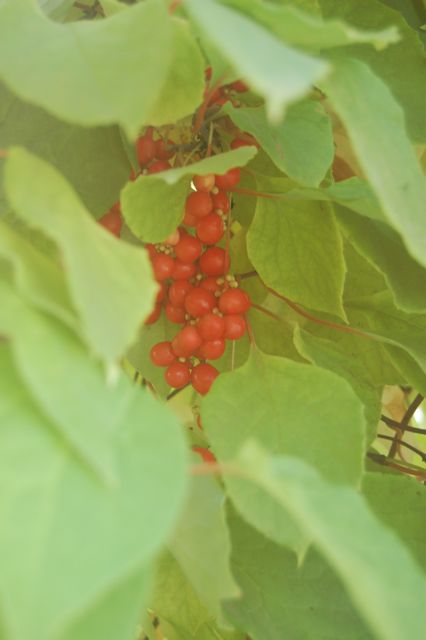
Schisandra chinensis or five flavour
berry is ripe. We had one the other
day and it is was a rather powerful
taste. They say one berry is as good
as five cups of coffee and I can see
why.

The first of the squash plants harvested and the beans
from the field. Those beans did okay, but another section
was dreadful. I got a handful of beans at best.
It has been a time of harvesting and clearing this week. We want to get a container to store things in and we needed to put it somewhere out of the way, which meant clearing a whole load of wood that hadn't been dealt with, some was okay for burning and some was past its best. The wood that was okay was re-stacked neatly and the stuff that was past its best was put down the field where we grow some of our crops to make another hugeltur pile. It is basically a pile of rotting wood, covered in hay and compost for plants to grow in. It will help to build the soil in a low lying area that easily floods - well that's the plan and if we can get our act together and not let it get too infested with weeds again.
The tidied site, ready for a container

Not many red grapes left now. The
tomatoes were denuded today to ensure
that we don't have blight in the
greenhouse and also to hasten the
ripening of the tomatoes. You can also
see a couple of bunches of beans
hanging, these ones should be red in
colour. The ones in the field were beige
We have now cleared the land of short beans, onions, carrots and buckwheat. None of them have been sparkling in the amounts we harvested, but we have plenty to keep us going over the winter. It is still amazing to us as we stuff our faces with the most gorgeous red grapes that they have cost us very little to grow. Admittedly the greenhouse cost us to grow them in and the original plant to buy, but year after year it keeps us in grapes for quite a while. It would cost us a fortune to buy them in the shops for sure and they would only be a big shop treat, as there isn't a huge range of fruit and vegetables in our local supermarkets, especially over summer. There is no need to stock a huge range in the shop as so many grow their own around here. So as the red grapes are nearly gone, the green grapes are just about ready and shortly after that a different kind of red grape. The dark grapes are earmarked for wine, although they taste nice, they have a lot of seeds in them. It is not just grapes of course that we are tucking into and one meal last week I counted 12 different vegetables and two herbs. Quite a range for one meal and would have cost a fortune in a restaurant, as some were quite unusual like the cucamelons.
Only the second load of tomatoes on for tomato sauce.
Good job we still have some in the freezer from last year

We often stay out in the caravan these days and one night
the sky was clear and full of starts. It is so amazing the sky
at night where we are because there is so little light
pollution
As we were collecting in our sometimes rather poor harvest, it still made us think that we put in a certain amount of seed and we still get back more than we put in. The potatoes were especially good this year, as I mentioned last week. The carrots were not great per seed, but the seed was old and some of the carrots I pulled up this week were huge. The large carrots will be kept to provide us with more seed for two years time, since they continued to produce even though the seed was old and in a rather poor year - always a good point in its favour and the size was good into the bargain. It is often said though that the market is the most efficient way of dealing with demand and yet so many anomalies occur to disprove this. A farmer plants a seed and it returns 8x, 30x, 100x on the investment, but it is still might not be enough to make a profit, because other costs can suck the money away or in a good year the abundance drives down prices. Other inputs can also cost too much and on top of all that the system is skewed. All that even when the products are in demand. How is that efficient?
It is not misty in the greenhouse, but
the lens on the camera. It is still possible
to see the height of the sweetcorn though.
We may have one or two cobs, but the
majority is for seed for next year.

The mornings can be glorious too
It is also hard to judge demand as well as difficult to judge what is going to grow well in a season. We grow a variety of crops, so that at least something does well. Our broccoli was doing very well and then we were caught unawares by the munching wee beasts, aka cabbage white caterpillars. We now have skeletal remains, they may recover in time to give us some more broccoli. The kale will recover, but we had hoped to have far more and be able to feed it to the chickens in the back end of the year when they are in the greenhouse and I am not so sure about that yet.

Monday, 27 May 2013

How's your Irish?

10:30pm and still a lot of light left in the sky
You can never say that my life is boring just lately. On the one hand I have been able to relate to a post on the Ploughs and stars project blog, where the author is pictured lying in the field exhausted, just resting his aching back and gazing up at the sky and on the other hand I needed to rest my aching brain, after translating from Irish English to Latvian English. Our neighbours who own a wood products company were a little nervous at the prospect of a meeting with an Irishman about some business and discussing everything in English. I usually take the phone calls, as it is always pretty difficult to speak another language over the phone with no visual clues as to whether you are being understood or not and usually face to face meetings are easier. No disrespect to the Irish, but they do love a good "crack" (translation talk) and at quite a pace too.  I think it is quite a while since I have had to keep up with talking in English at quite that speed, even though I did have a lovely chat with an Irish lady, a friend of my daughter's, whilst in Australia. I'm not really sure if the meeting was successful or not, our neighbours will have a lot to discuss, but at least the actual meeting went smoothly enough and I think the translation went well.

I haven't really been lying in the fields, but it is tempting. The problem is I am always afraid of the multiple varieties of insect life we have in our grassland to actually just lie down in it and that is from previous experience. Ian has continued to cut down a lot of the grass to try and reduce the problems of the flying biting ones that we have a lot of in the early summer and the hope is that it will make life more pleasant for the alpacas this year. We have already started with the mosquitoes, but fortunately they are more of an evening insect and hot weather or windy weather keeps them at bay and makes for a more pleasant time. Everything is growing at such a pace now and of course the grass is no sooner cut than it looks like it might need doing again. I have got quite a bit more gardening done as well as managing to end up with sunburn on my lower back - note to self, where a longer t-shirt of put suncream on there. I also took advantage of a couple of rainy days to work in the greenhouse, a job that has become almost impossible on the sunnier days, consequently all our tomatoes are now in and most of the melons. We are trying two new varieties of melons this year, to see how they fare - Lada and Vidzeme.

That rather thick custard is an absurdly yellow colour, not
from food colourings but due to the eggs our chickens lay.
We have had bright yellow cakes and intensely yellow
boiled eggs too, all because our chickens get access to grass
We have eaten well this last week, asparagus has been featuring widely in the diet - don't worry not too often, especially with its rather embarrassing consequences. One evening I prepared an asparagus, onion leaves, and pea-top omelette, served on a bed of lettuce that had grown from seeds leftover from feeding chickens with gone to seed lettuces and carrots that had been stored over winter. The only items not grown ourselves was the salt and oil and even the oil was a cold-pressed rapeseed oil from Latvia. Other treats were the scotch pancakes served with dandelion syrup that I made last week. That syrup worked rather well, so well in fact that Ian helped me pick a bucketful of dandelion flowers so that I can make some more of it. It is a long time since I have had any maple syrup, but that is what comes to mind when I taste the dandelion syrup. We have had dried apple slices, as we tried out the solar dryer that Ian made last year and that failed due to the lack of sun, or solars as we keep saying. This year a day in the solar drier and the apple has been just about successfully dried. We have so many eggs that we are having difficulty keeping up, but I'm guessing we will have plenty of help soon as our new chicks are ready for hatching out in about 10 days time and about that time we start with the influx of family visitors. We candled the eggs (shone a really bright light through them to see if there is life) and found that three definitely have not been fertilised and two are suspect, but the rest seem to be developing well. So keep watching this space for lots of cute chick pictures soon.

Our eggs in the incubator
I have had to balance the gardening with my uni work though, as I have a few rather close deadlines for things that need completing. One of them is a study plan, that has taken far too long to sort out, but it is now acceptable and ready for sending off. I also have an academic paper to write for a conference that had to be fitted into two pages and not the normal length of a paper which seems to be around 12 pages. It is my first attempt at writing one of these and there were a few new things to learn along the way, such as having to look up "corresponding" in the dictionary for a new version of the word, as in a person who deals with written communication. I had just never used the word that way. When I told Ian, he looked at me in surprise that I didn't know that. Okay I know you have correspondents who write articles for newspapers but corresponding to me was always used in terms of something matching something else, like someone's views corresponding with someone else's views. I am quite pleased that it didn't take too long to write and didn't require a lot of amendments. That is always helpful. There are times I can completely miss the point and fortunately this wasn't one of them.

The prodigal returned, looking a little dishevelled
I forgot to mention our cat went missing for a couple of days last week, she returned on the night we were shearing Herkules our alpaca. I don't know why she gets wanderlust, but it seems to be a regular thing with her. Last year she disappeared about three times, sometimes up to a week at a time. That was usually after a telling off or after she was given tablets which seem to traumatise her. This year, there didn't seem to be any reason at all, unless she was doing a thorough sweep of our forest for tics - she is an absolute tic magnet. Hopefully though the tic medicine will soon sort her out and keep the wee beasties at bay.

It is often said that "there is nothing new under the sun," in fact it is a saying from the time of Solomon, so it has been around a looooong looooong time. The quote below could have been taken from yesterday's paper, the subject matter is so relevant, although perhaps nowadays it is not just Continental farm-produce but worldwide produce.
The fact, however, that Continental and other farm-produce of all kinds can be sold in our own markets at less than would be its cost of production in this country, while the quality is often superior, goes far to prove that there is something in their knowledge of the subject and that it is not all the result of cheap labour or a better climate. "Stephen's Book of the Farm"(1888)
Ian has been reading this book in his downtimes in the caravan and finding it fascinating. The book was used in the programme Victorian Farm as a reference book for most of their activities. It helps to know what some of the more primitive implements were used in the smaller scale farms and how some things were harvested or stored in a less technological age. Sometimes it is good to revisit the past and see if there is anything that has been forgotten about that might actually be relevant for today, it is also good to find out the things that are best forgotten about for good. Not all old practices were bad and not all old practices were good.

Still waiting to go out in the garden, more squash plants.
Let's hope they fare better than one lot, which is being
inundated with snails.
Well I have nearly finished waffling on, but just want to finish off by one of the low points of this week. Having flown all the way to Australia, we had been hoping for a nice lot of points put on our Eurobonus airmiles card, but no! Between Scandinavian airlines, Singapore airlines and Star Alliance the partnership they operate under we find we are not going to get the points. When you book you are allocated a booking class and for some reason the ones we were booked onto, was for booking class Y that does not accrue any points. The problem I have with it, is no one books to get a particular class of ticket, you just book the cheapest on the day, whatever that might be. It seems therefore an utter lottery as to whether the flights are due to get points or not. It doesn't exactly make me feel inclined to be loyal to either airline either now. I think I will be looking at other loyalty cards then, as I will be doing a lot of travelling over the next four years.

Monday, 13 February 2012

Got a handle on this?

Updated link that wasn't working

The door handle! Are you impressed?
Before I start I have to set something straight, I inadvertently forgot to mention a momentous event that happened last week in our home. Ian ..... wait for it!!!!!!! put a handle on the inside door. Why is this momentous? Because it has taken him nearly four years to get around to doing it. For the past four years our inner door was opened by sticking our finger into a hole and pulling, not too bad when you know that and not too bad until winter time when gloved hands get a bit too big and then it gets awkward. So I'm glad I put that straight and now I shall get around to the news from this week.

The stuff of life! It is in this temperature.
This week hasn't been as cold as the week before, still low at around -25C (-13F) at night and up to even -6C (21F) one day in the sun. This was certainly an improvement on sub -30's (-22F) the week before and lucky if we saw it below -20C (-4F) for most of the day. Our apartment heating, however, did not improve much this week, it has been up and down all week, no consistency at all. I was even surprised that there wasn't a huge improvement during the Latvian Schools Winter Olympics that is held every year here. I wonder how much of that was to do with a much scaled down event this time, it had finished by mid-day on Saturday and so no fireworks. It is sad when the countries economic woes hit events like these, but I guess there is the added expense of the Olympic games in London this year for the Latvian Olympic committee to fund. We had another meeting this week with the mayor and the director of the heating company together and at least it helps us to understand what is going on and how we get our heat and the issues involved. The next step is to carry out some experiments to see what effect the recirculation pump has on the heat we get - gosh somethings are never straightforward, but Ian is in his element helping to devise experiments and looking forward to analysing results.

All in the cause of research of course! It's a
hard life, but here is the hot chocolate
pudding, a bit too runny this time.
We have eaten well this week, part of the reason was that we had invited a young friend of ours so that our translator, who has been helping me to interview local farmers and hunters, could have someone to connect with, who was more his own age and possibly some similar interests. To facilitate that we dug out the free range turkey, we were given by some other friends and laid on a lavish feast. Well any excuse really for a good nosh up. So we had roast turkey, roast spuds, a rice mixture (okay I forgot to check how many spuds we had and we didn't have enough for mash as well; wouldn't mind but we have sackfuls of them but up at the other apartment), some other roast veg and of course Yorkshire puddings, all followed by a red and blackcurrant sponge with Ian's home-made ice-cream. It was rather nice, if I do say so myself! Later on in the week we went to the hotel and had to carry out an experiment - in the interests of science of course! We had to test the chocolate puddings as sometimes they are runny in the centre, which they are supposed to be, and sometimes they are completely set but still make a yummy pudding. I explained this to some students in the student cafe I monitor and one of them asked me how often did they came out right? I guessed that 75% of the time they came out just right but of course I wasn't entirely sure, cue excuse for an experiment. Ian, ever the scientist, said that we had to carry out the experiment at least 20 times to be sure and so we have started on the challenge. Mind you I don't think we really are going to carry out the experiment for 20 times, it will take far too long to get the results and it is the most expensive dessert on the menu (If you want to make it yourself then here is a recipe if you missed it in a previous blog link).

We are not the only ones with wood stores, here are just a
few. 
To top off the week of good eating we finished off with a jar of venison and wild boar which had been produced by one of the ladies who used to attend my English class. Her husband is a hunter and I got to interview him this week for my course and he came with his good lady wife and laden with three jars of a meat product. I say meat product because I can see it has a bay leaf in it and meat, but apart from that I have no idea of the rest of the contents. It was tasty and in some ways reminiscent of a tin of corned beef, but with chunks of meat instead and I guess none of the fillers and nitrates that normal corned beef has. Ian was elated to have found something like corned beef and I have a feeling that the next jar will be reappearing as a meat and potato pie or more likely something resembling a corned beef hash pie. Although we do love the taste of corned beef, the last time we actually had some, we both ended up with sore mouths, as the preservatives used in those kinds of products causes some sort of an adverse reaction now we are not used to foods with chemicals in it - well if you discount salt, fat, oil, vinegar, citric acid and those sort of chemicals which I add to bottled foods.

You can see a wild boar track quite clearly on this picture.
How can we tell it is a wild boar? Wild boar are heavy and
have short legs and hence they leave a wide trail in this
depth of snow. Last year the metre high snow made it
difficult for wild boar to even get around.
The interviews, for my course project, are going well again this week and I have interviewed another farmer who gave us the telephone number for someone else, a local State Forest Service senior forest ranger who is responsible for hunting at the local level and another hunter who is trying to get local hunting organisations to work together and to improve how they work by the creation of a new hunting association. In the last interview of the week I got to see a wild boar face to face but fortunately for me, not the wild boar of course, it was hanging from a ceiling in the process of being butchered. The interview with the hunting association organiser was at a facility which included a place where the hunters can go to butcher the meat they have shot, hence the gruesome scene. I have to say it was a grim satisfactionto see it up there, knowing all the damage they can create in just one night, although it was kind of sad too. After all the wild boar are opportunists and well fed ones at that, and that is why their numbers are increasing - man's fault really. Apparently wild boar won't eat all potatoes though, you can get a spray that will stop them eating them - question is would you eat potatoes that have been sprayed with something that wild boar with their sensitive noses refuse to eat?

Our greenhouse is still up! Yeh! The internal supports
though, no longer rest on their plinths but are about a
centimetre above due to the outside ones rising in
the frozen ground as the ice expands.
So as I said we have eaten well this week, meat with no artificial preservatives, and certainly free range. You can't get much more free range than an animal shot in the wild. Our feasts usually don't cost that much, due to generous friends, but what would happen if we were to buy it? Would it cost a lot? In some ways it should due to the effort gone into obtaining the meat. Even our veg that we have eaten this week has all been won from the land by the sweat of our brows. Good food, however, only appears expensive if it is bought, because we don't see the hidden costs of the cheap food. Tax payers money is often channeled into producing factory farmed meat, that is no good for us or the animal, but since no one actually pays that at the till it makes the food seem cheap. This is a big problem with the system we have, that penalises the small producers for producing good quality products and encourages damaging industrial processes (see here for an article that goes into more depth on the issues).

Cold weather often brings some glorious
sunsets.
I have been a bit bewildered just lately by the differing comments that are all supposed to have emanated from the IMF. On the one hand Latvia is supposed to have emerged stronger than ever from the crisis, not sure how many Latvians would agree with that analysis though. On the other hand the Latvians might agree with the emergence of the fact that the Latvian crisis has exacerbated poverty and fuelled the rise of inequality. So the IMF thinks that Latvia has emerged stronger when inequality has increased and yet according to many reports inequality fuels instability, the more equal a society is the more stable it is - surely the strength of a nation should therefore be measured by its equality? The IMF has also stated the safety net was important to the recovery - what safety net? The one that guarantees a minimum of 40 Lats a month when our heating bill was 40 Lats this last month? Or is it the one that guarantees 40 Lats a month when the minimum amount to live on is 164 Lvls (or is it higher now)? These sort of conflicting reports do not really help nations to move on from a crisis. The measurements of what is a success and what isn't should really rest with the nations inhabitants who have to live with the issues and the consequences and not some dependence on a discredited financial system that has not aided many people to find a satisfying lifestyle, that meets their needs.

There's a river there somewhere! The
continuing cold weather has meant that
most rivers have now frozen over.
Over the duration of my course I have been looking at issues such as resilience and so one article on why some people don't get depressed caught my eye. The article was looking at what makes an individual resilient? But I think that perhaps is the wrong question? It should be what makes a community resilient? Communities are the backbone of life, separated off, isolated individuals with everyone in their place does not breed resilience. A mix of people, the cranky, the friendly, interacting makes a community and breeds resilience. You learn how to deal with people and you can learn from people how to deal with life, people need robust resilient communities to become resilient and to pass on resilience to others.



Monday, 15 August 2011

Interesting times

There were a couple of moments this week when I didn't recognise someone, very embarrassing! The first person I didn't recognise as they were waving at me, was due to a radical haircut. It made a huge difference, and that is my excuse and I am sticking to it. The next occasion was when we walked into our local hotel. I saw some people sitting at a table but didn't initially take much notice, and then suddenly I realised I knew two of them and was frantically racking my brain to remember who they were and where did I know them from. Eventually I did work out who there were and they weren't from the village and so it was quite a surprise to see them in our locale, especially as they were from Riga, they are also friends of people we know are away at the moment and so they hadn't come to visit them either. It is odd how we do not recognise people out of context, I guess that tells us something about how our brains are wired. It did mean though that instead of a quiet meal for two as usual, we had lovely evening where we were introduced to someone else who lives in Riga but comes from Lancashire like me. We traded jokes and were able to talk "Northern" and be completely understood, it was great. Just hope I recognise our son when he gets to the airport tomorrow (I am writing this ahead of time so I can spend time with him catching up instead of sat on the computer)


Talking of brains being wired differently, it is funny how our perception of old changes with age. One young lass who translates for us on a frequent basis has found a dictionary that is really old and contains some of the terms that we were struggling with the other week. This very old dictionary was printed in ........ 1968! Old!!!!! That makes us old! That makes us very old!!! We were expecting her to tell us it was from the 1930s, now that's old! Well it is to us, being early 60s children.


Since coming to Latvia we have been eating very well, of course there are the fresh vegetables from the garden and this year we are starting to get gifts from friends, such as lampreys earlier on this year, beavers sausages, goat's cheese, chicken the other week and this week we have got half a goat. The lampreys we have to work our way up to eating, they are good but smell very fishy which we find off-putting, but paired up with some strong tasting vegetables and herbs it works well (still got a packet in the freezer). The beaver sausage we are still working our way through too, as it makes good salami for pizzas or a tasty casserole and it hasn't been casserole weather. The chicken was a free range hen that was past its productive years and so had to be cooked for a long time, but it made a lot of tasty juice for stock and still had a taste itself at the end. It made a lovely chicken and mushroom pie and yes the mushrooms were picked by Ian fresh that day. As for the goat? Well that is in the freezer as we haven't had chance to eat any of it yet, I will let you know what it tastes like when we have eaten some. It does show though that you can live very well, quite cheaply when you live as a community. We have also learnt to make many foods that we took for granted in England, such as cheese, bacon, hams, sausages and found that really they are not hard, just not so instant as opening a packet from the supermarket. I planned on giving our son some home-made bacon sarnies one day while he is here but that meant buying the meat Saturday, adding salt and honey to it in a plastic bag and turning it every day for four/five days so it will be ready Wednesday.  


I mentioned last week that Ian keeps saying "winter's coming" well this week it did rather feel like it too as we have had some rather cool, rainy weather, fortunately it seems to have warmed up a lot in time for our son's arrival. Even the trees and vines have started changing colour. The rainy weather has meant that it has been difficult to get into the garden apart from the smash and grab type raids to get some veg from the garden before the next shower and so the weeds which were bad before have increased. Finally on Saturday I got in there and did battle with the weeds, which succumbed reluctantly. There are now three rather large piles of weeds complete with pulled up peas. I managed to rescue enough peas that hadn't been munched by grubs to add to our pie and they were good, just a pity there hadn't been many more of them. I did do some research and found that one of the best deterrents is fleece or fine netting to protect from the moths that lay the eggs, so I think I am going to do an experiment to thwart the beasts, one will be to cover them and another to grow something amongst the peas to confuse the moths, maybe nasturtiums and/or dill. If anyone has any other ideas please feel free to add a comment. I decided against the pheromone traps as they are just too expensive whereas the dill is free as I keep the seed - there's some drying in our bedroom as I write and so are the nasturtiums - if I manage to get some going to seed and the frost doesn't get there first.


One of the good things about winter though is the respite from the garden. There is not much to do in it when it is a metre deep in snow and all there is to do is to plan for the following year. I can really relate to one comment I read on a blog about farming this week
 "One thing that has surprised me year after year is that in spite of all the challenges we New Hampshire farmers face every season we all return for the next summer. The winter seems to refresh and completely renew our motivation for growing and doing what we love."
I can really relate to that. I was looking at a plot of land today and planning for next year as I would love to increase the number of blueberries bushes we have and there is a triangle of land that is between paths and is a jungle of ground elder and wild raspberries. By laying a thick layer of cardboard mulch and then straw and pine needles on top by spring there could be a good soil layer for the plants and hopefully no weeds. Winter will do its work too. 


Our land is our investment for our future. Often we are making decisions that will not be realised for many years, maybe even after we have gone. We are keeping many of the trees that have seeded themselves, some we remove when they are just plain in the wrong place, but if it can be kept and Ian can still manoeuvre around them with a tractor then they are kept, they will provide shelter for animals and fuel for us in the future. Oaks are something we are particularly keen to encourage and yet we may never see the fruit of those, although I would like to try coppicing them as they can be used for straight oak beams - they only take about 25 years I think! Just in time for our "retirement"? Actually past our official retirement age as that is just less than 20 years away (scary!). We are hopefully going to tread slowly into alpaca keeping next year with just a few to see how they cope with our land and our winters before embarking on rearing. They will still provide us with a few woolly jumpers anyway. 


I see these sorts of investments, along with learning how to keep seeds as the best way into our future. Banks used to be thought of as nice safe places to store money and trustworthy places to invest our pensions, now I am not so sure. There are so many question marks over the way the economy is run and how sustainable it is that even the experts really do not know what they are doing, they are guessing too and often just praying that everything will return to normal and it will all go on as before (Delamitri yet again? here and here). The riots in England this last week should be yet more warnings that things cannot go on as before and reverting to authoritarian rhetoric isn't going to help either. I am not going to say much about this as so much has been said already and most excellently on this blog, which talks about the result of investing in the rich and in consumerism that has, like Roger's blog says, meant a lot of unexploded land mines waiting to be triggered. This blog also gives a good account and I especially like Cheryl's comments if you scroll down, where she argues for a return to living together as a society.


As Christians we are told not to store up our treasures on earth but store it up in heaven


 Matthew 6 19 “Do not store up for yourselves treasures on earth, where moths and vermin destroy, and where thieves break in and steal. 20But store up for yourselves treasures in heaven, where moths and vermin do not destroy, and where thieves do not break in and steal.21 For where your treasure is, there your heart will be also.

Thought you might like a cheery picture to
finish with! A photo of our sunflowers. Sorry
haven't got around to taking any more but
maybe tomorrow I shall post some
But what does that mean in our lives today, we often spiritualise it to oblivion and still don't really tackle what it means. The Lords prayer says "Let your kingdom come, let your will be done on earth, as it is in heaven." To me that means we are praying for heaven on earth, so invest in that. Again what does that mean in practice? Well I can't give you an definitive answers because it will be different for each one of us, but instead of looking to make an eternal difference, look to make a difference now, here on earth using kingdom principles of equality and fairness, and don't store up the money for the future. It is okay to give it out with the expectation that it could come back to you (and I did say "could", it won't always) and then recirculate it again, using it to build up, encourage and restore.There are plenty of folks that need a hand to get started on a project, so invest time, and money into those places. Get a group together to see about investing in some small projects - that's called spreading the risk. Just do something, don't get sunk in despair or believe it is all going to hell anyway and not do something about it. There is a God in heaven who is in the business of sowing encouragement and love into a hurting world and he is into transformation, so sow into it. Get behind what he is doing. 

Monday, 20 June 2011

Sweet blessed rain!

Rain clouds gathering, and most welcome they were
Well our drought is over finally and our ponds are filling up nicely. It was worrying to see them slowly disappear along with the forecasted rain that never arrived. The bottom pond dried up so much that Ian could get the tractor in and so he put the back hoe back on and started digging it a bit deeper, to see if there was water further down. After digging through a peaty layer he found two drains - Bingo! The water was still slowly pouring out of the drains and so he had found another source of water that hadn't dried up with the lack of rain and we also have a lot of peat for compost for next year. Our drought ended firstly with a couple of good soaking rains, for which we are grateful, as we had planted seeds in anticipation of the rain and didn't want them all washed away. A deluge after a drought just means the water will run off and not really wet the soil which is not what we wanted. The deluge did arrive later though and in fifteen minutes of rain our first pond rose about 20cm to the overflow pipe, our second pond had a puddle that didn't last long and our bottom pond rose up past the deep hole that Ian had dug and into the basin of our original pond. Much better.

I think this must be a butterfly that has just emerged from
its chrysalis, waiting for its winds to unfurl
I mentioned last week that we were having trouble finding buckwheat to plant in our ploughed field and I had our scouts out trying to find some, well one came back with a successful report, a farming friend had just sold a load of seed, but he did manage to scrape together enough from his barn for us to seed our field with. The grand total of 19 kg of seed was 5 LVLs ($10, £6) but an hour and half drive to get it. Our friend has a hunting ground for people to practice and so we got to look around, as well as venture across a rope bridge. I managed it, but wasn't too good at scrambling across and Ian couldn't help me across as having more than one on the bridge at once only made it worse. At least I managed to avoid a plunge into the river below. We were also presented with some beaver sausage and just in case anyone is wondering what a beaver sausage is, it is a sausage made with beaver meat. Don't want anyone getting confused now!

The grass has grown so tall this year, about this time last
year it was only just above knee height, this year
it is taller than me and nearly as tall as Ian.
Ian managed to get the buckwheat sown in the field using the old-fashioned broadcasting method and then turned it in slightly with a chain harrow (a bit like a giant rake) and, with perfect timing, the rain arrived later in the day to water it in. It was a bit disheartening though a few days later to arrive out on our land to see a flock of pigeons busily grazing the field, feeding their fat little bodies with our buckwheat that we had tried so hard to get. Ian shouted at them which startled them and as they were about to land I waved at them madly, as I was wearing a bright red sweatshirt it seemed enough to see them off. The following day though they were back as expected, but I discovered that whacking a pair of trainers together makes an excellent pigeon scaring noise. Kept me busy in between the rain showers, weeding vegetable plots, planting seedlings and cleaning the caravan.

More unwelcome visitors, the pigs are back, not so helpfully
digging up a grond elder patch that Ian had cut.
This month so far our outgoings have been really low but we have still managed to eat well despite that. Our garden is just starting to produce some leafy salad type things and our strawberries are beginning to turn too and they are delicious. We were also given 3 litres of goats milk the other day and I managed to make goats cheese using nettle juice and some kefirs to form the curds. It turned out very well, just like a traditional goats cheese and all the whey that was produced is being slowly used up to make loaves of bread as the whey makes a lovely moist soft loaf. So you can see that we are certainly eating fine foods on a limited budget, which reminds me of what I felt God say not so long ago "Wait and see what the Lord will do!" He is certainly providing for us in some amazing ways.

A present Ian made for me, isn't he kind? 
We received an invite to a name day celebration this week for one of the youngsters in our apartment block. Name days in Latvia are big occasions and they are listed on calendars that you can buy, so that you can know when all your friends will be celebrating their name day. It is traditional to take a small gift to friends celebrating their name days, but doesn't always involve a party The idea for this one though was that a few of us would get together to build a tree house for the children, which would be a bit safer than them trying to build one for themselves. Well that is the theory anyway as one poor youngster managed to step on a nail and he ended up going back to his mum who happened to be a doctor on call that night. Apart from that incident the rest of the night went quite well, I even gained a new best buddy. One of our neighbours has a young son who is often shy of us due the fact we don't speak Latvian, but for some reason on this particular night he decided we were friends and we played badminton, or rather as much as you can with a three year old, and shared crisps. The next morning though we were back to normal and he seemed to be shy again. Oh well! It was nice while it lasted.

Look carefully and you can see bees. These bees have
made a home for themselves in our straw pile
I have definitely finished my post graduate diploma in Managing Sustainable Rural Development now, as I got my mark for the last module this week. I am not sure of the final mark exactly as it all has to be verified but it is looking good and I am very pleased. It means I can move onto the next bit now and get started on the Masters thesis. This should take me 8 months and so hopefully I might actually be finished early and get into the sowing season a bit earlier next year. Well that is the theory, and this is Latvia so it may take me a little longer, especially if it takes me a long time to organise interviews with farmers.

A gorgeous looking beetle
One of the questions we get asked a lot here in Latvia is, what are we doing here? Good question really and we sometimes wonder ourselves. We definitely can't be said to be farming properly, as we are still in the learning process and we are not sure if we ever could make a real go of it at times. We do try and move forward without damaging the lovely piece of land we are privileged to be working on though. We often get caught up in the beauty of what is around us and we have no wish to disturb some of the equilibrium. We are also trying to work some things into the natural lay of the land, for instance planting woodland bushes such as blackberries, tay berries and blueberries close to groups of trees or only digging up areas that have become covered in invasive weeds such as ground elder. We certainly wouldn't want to dig up the whole meadow as to do that we would lose some of the gorgeous orchids and other wild flowers that are abundant. The problem is though that although it puts food on our table, it doesn't put cash in our hands to pay internet and electric bills. We still have plenty of savings but it won't last a lifetime and so we still have some way to go to answer that question but I do feel that God gave me some of our purpose for being here as I read Acts this week in the Message.

Acts 3:22 For the time being he [Jesus] must remain out of sight in heaven until everything is restored to order again just the way God, through the preaching of his holy prophets of old, said it would be.

Another pretty little butterfly. There were so many pictures
I could have put up this week of the insect life on our land
I feel part of that restoration is restoring a garden to what it should be, namely a productive pleasant place to be. I also feel we are helping to restore some trust as we help where we can, and I feel we are also restoring hope to some people too. How does that provide us with an income in the future? No idea! But I do know God provides in some creative ways and so I am not too worried about that. In some ways I feel that what we are doing is similar to what a prison warden in Hawaii is doing in providing a healing environment for prisoners. Latvians often feel imprisoned in a hopeless place, they love their country and want to make a go of a business or farm but the circumstances of their life or the economic environment traps them into a feeling of hopelessness. I do hope that our garden/land will become a healing place and what we do provides healing. The prison warden in Hawaii is certainly providing proof that there is a way out of hopelessness and despair and it needn't trap people forever, now that sounds like restoring God's order to me!
This is the marjoram I harvested this week for drying

These incredible eggs were on a marjoram leaf. They are solid
little balls arranged so perfectly

The re-re modelled pond. The pool in the middle is from the
digging that Ian did this week where he managed to dig down
to the drains

A marsh orchid (I think), there was a whole glade
of these pretty orchids