Showing posts with label hay cutting. Show all posts

Monday, 28 June 2021

Summer time!

Windows open and curtain on the outside of the
half door for ventilation and to stop the cats 
jumping in. Curtain on the inside of the half 
door and the cats jump in.

We finally got the caravan moved out of the greenhouse, just before the heatwave with the hottest nighttime temperatures on record in Latvia. There were red warnings for extreme heat throughout the country with temperatures well over 30C during the day and not dropping much below mid-20s at night. It was also a humid heat and I ended wandering a round with a sweat rag (I know you all wanted to know that!). Even my glasses steamed up outside from time to time. 

Those ears! She almost looks like a llama. The
tips are probably covered by a membrane that has 
bent them at the ends as her ears now look much
more like an alpaca's ears.
Amazing what a bit of warmth and rain does to the
grass. It was not that long ago when it seemed so
short.

Getting the caravan out of the greenhouse was more difficult than previously because we were a month later than usual. We did have to cut back the grapevine a bit and Ian had to mow the grass first - a novelty as normally the grass is only just growing when we move the caravan out. The problem is that the caravan now sits in the sun all day and in the greenhouse the shade would come round to it by evening. To cope with the heat we've had two fans going during the day and we've been going to sleep later with one fan still going through the night. Not ideal but at least we could sleep. We did have one day where we ended up catching up on some sleep when neither of us could make it to lunchtime before the desire to snooze got too strong. 

GT is such a photogenic cat. He's also turning out
to be quite affectionate, which is a bit of a surprise.

Ian cutting grass for hay.

We took advantage of the hot weather to start cutting the first hay of the year. Despite the heat and the fact most of it dried out very well, some of the bales seemed really heavy. Some of the grass was still obviously very moist. Hopefully they will be okay and they are in airy places to continue to dry out. It did mean that it was exhausting work though getting them stacked. We needed the space to get the girls out on to the grass and they would have been in the way of haymaking if we didn't cut the grass first. We don't want them too close to the forest with a little one, especially where we cannot see them so easily. Too many foxes mainly but there are also lynx, wolves and even sightings of bear tracks not very far away recently. 

Some much appreciated shade.
Silla and bump sunbathing

We are still waiting for the June babies to be born. They seem tantalisingly close to giving birth on some days and then the next day all is well and the time drifts on. In the meantime we've started on mating some of the others. We've had to use Tellus though, as he is our most reliable stud male. Mr. P. has too many asthma/hayfever type issues that we want to get to the bottom of before passing on any more of his genetics and the younger boys are generally too immature apparently.  

Aggie getting her nap time in too, but still no baby.
It's a hard life being a cria

Brencis was the father to the first this year's cria but he has such a big fat belly on him he's struggled to mate with another female, Antonia, so we brought in Tellus who managed to mate with her, but she's a crafty one. She seemed to throw Tellus off at strategic moments, so no idea if Tellus was successful or not. Antonia also intimidated the younger males and they obviously have not inherited the sex drive of their fathers and still need at least another year to mature - or at least that is what we hope is the issue. We tried George with a very compliant and flirty female, Ilvija, and he ended up kicking her off, it should be the other way around. At least Valeria was much more compliant with Tellus than she was with Mr. P last year and we just have to wait for 7 days now to see if he was potentially successful - yes the spit-off tests begin. 

It's a hard life being a cria's mum too.

Ilvija at the back with her Mum, Chanel, 
investigating the new arrival.

Ilvija has managed to escape a few times this week from the girls' fenced off area. She started to get a bit adventurous or she was just panicking and looking for her mum. She's a bit unpredictable and so not so easy to catch. Sometimes her mum starts getting stressed looking for her and then gets spitty when trying to usher Ilvija through the gate. At one point, Ilvija alarmingly headed down towards the road with a bit of a gallop. You should have seen me run, or maybe not! I lolloped in her direction and headed her back towards a safer spot, only she was rather interested in the boys and the boys were rather interested in her. Not a great place to be with 8 un-castrated males and one flirty girl and only a fence between them. I managed to get hold of her and Ian and I wrestled her down to the ground. I held her down while Ian got a harness and rope. Not a good time to introduce her to harness training but the first opportunity we've had due to her spitty mother. With a bit of patience and pushing at times we got her into the gate of the paddock without her mother realising and so avoided the spit fest.

Rocket Ron is not so easy to photograph. He is 
turning out to be more of a wanderer that is also
a surprise. Anyway he's keep the mouse population 
down, so earning his keep. He's still reasonably
affectionate though and both are happy to be 
combed with the flea comb. I'm not so happy
they've got fleas though.
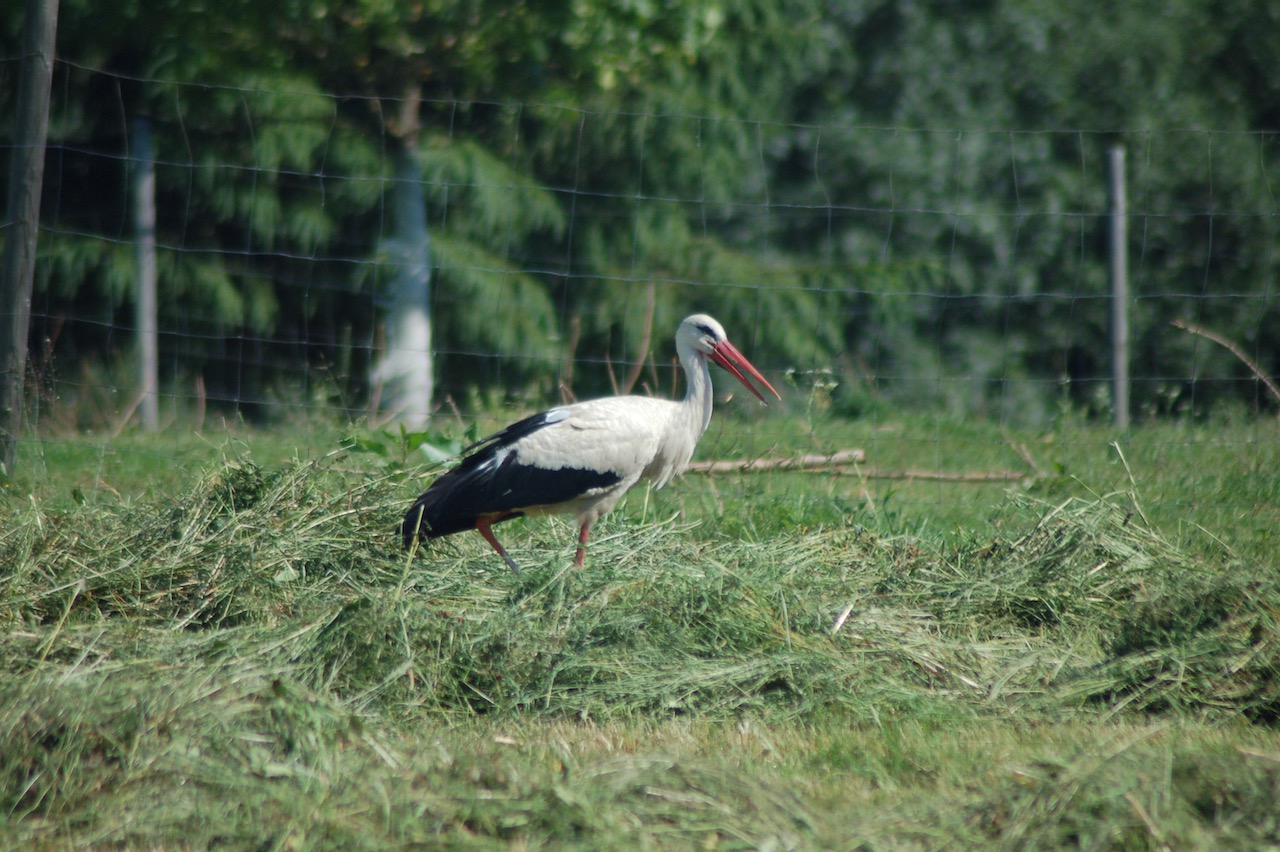
Or course haymaking means the storks congregate

We had a minor hiccup with the car this last week. I set off to the bakery to get our weekly order of bread, then to collect a parcel from the pick up point before heading to the apartment to get some water and a few supplies. All good, except when I came to set off from the apartment back to our land, the key would not turn in the ignition. Nothing I tried worked. It was also very hot as I hadn't parked the car in the shade because I only intended to be a few minutes. Ian was busy, so I pottered around the apartment for a bit and kept going back to try the car again. Nothing! In the end I contacted a neighbour and asked for a lift out to our land and to pick up Ian and take him to see if he could get the car going. With some WD40, the spare key and some fiddling around with a screwdriver he managed to sort it. A new ignition might be needed though as it must be pretty worn. At least the car passed its technical today and Ian was able to help out another neighbour when their milking machine broke and they needed to take it in for repair. 

Not sure if one is doing a display for the other or
they are having a disagreement.
A Marsh Orchid

Surprisingly this year I've mainly been able to keep on top of the weeding. Occasionally it seems like it will get away from me but I think the cold start to the year and the dry spell has kept them in check. So it is looking like we should have plenty of beans, onions and garlic, so that's good. The late planted tomatoes are also doing well with their very regular watering. I've also taken some cuttings from the side shoots to increase the numbers of plants, as that is the fastest way of increasing the number of tomatoes we have. We've started eating fresh mangetout style peas, strawberries and garlic scapes. I've noticed that the courgettes have also started, so let the courgette glut begin. 

Yellow Rattle. Apparently not
so good for the grass as it is
parasitic and can become invasive.
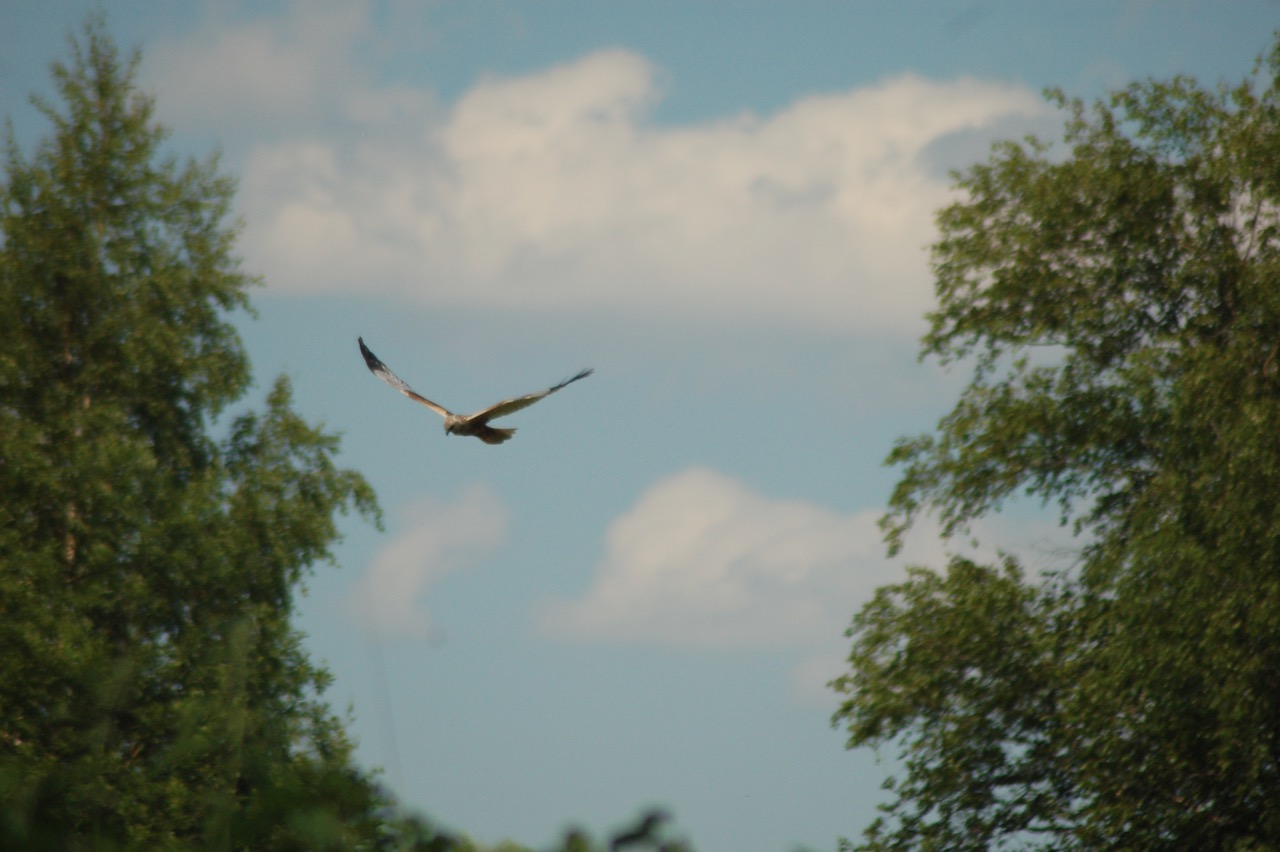
One of the reasons we do not have free-range
hens any more, a Western Marsh Harrier.

Ian finally managed to find time to repair one of the chicken arks, one of the first he made and still in reasonable shape after 10 years. He's replaced the roof with a tin one that makes it much lighter to move and repaired some of the base bits that are in contact with the ground. With new handles and door fastenings it is back in use for the hens. We left the cockerel in the old one for dispatching. The hens need a rest from him. I'm hoping that one hen will now get a chance to heal her foot, as she was his favourite. In between pacing backwards and forwards on midwife duty waiting for babies, Ian has also spent lots of time cutting the grass and not just for hay but also for my vegetable garden. It looks much neater now. 

One of the reasons for making sure our arks are 
more secure these days. Ian rang me and told me
to come quickly. I found Ian in the forest and 
pointing into the trees. He had startled a pine
marten and we watched amazed as it jumped
from tree to tree. Agile beasts for sure but also
quite vicious. Ian has seen one eat a hornet's 
nest and probably responsible for breaking into
an ark and dispatching 8 hens.

Early days and still unsteady on her legs.

You cannot have too many cute cria pictures

Karla is finding her feet now and running about.
Last minute avoidance manoeuvres to avoid 
grumpy Auntie Aggie.

All legs

Amanda is a good mum. The right balance between
care and letting her baby be cared for by others.

Karla has put on plenty of weight over the last
week and so we do not need to carry on weighing
her every evening now.

Karla is also starting to eat the hay already. She
looks a bit wet around the face because I've been
putting on fly repellent.

This thrush is a frequent visitor

Mari

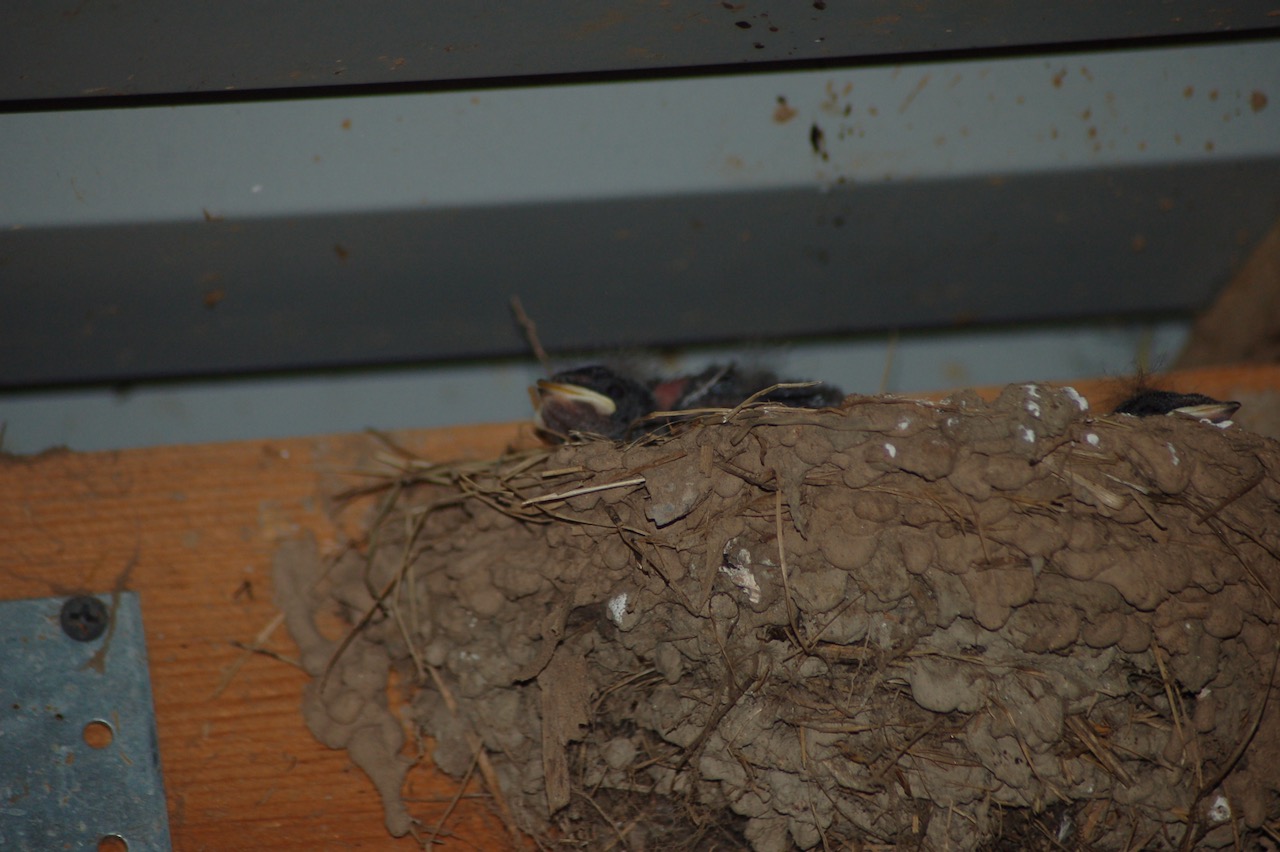
More newbies on the farm, baby swallows.

No not steam coming out of the caravan but a
well placed yoghurt pot and stone over a pipe to
stop the rain getting in. It was placed there by 
Ian climbing a metal ladder as a thunderstorm approached

Early morning dew on the grass turns it a pink hue.

Monday, 24 June 2019

A new sport?

Bales collected together.
Have you heard of Crown Green Bowling? Perhaps not. It is a genteel game, usually played by older people on a crown shaped, i.e. not flat, lawn in the northern parts of England and Wales. A great deal of skill is involved to ensure that the bowls travel in the right direction over the curved terrain towards a smaller ball, known as a jack. Now as you can imagine, if you follow this blog, the idea that I have taken up a genteel sport usually played by older people is not something I'm likely to do, but I did play something a bit similar today. I shall call it Crown Green Bale Bowling. The idea of the game is to assemble bales of hay into groups. Now our bales are not the huge ones, they weigh about 25kg and not 600kg and upwards like some you see these days.
The view from the oak tree hill of the cut hay

We can now see our alpacas again
Our fields are definitely not flat and so it is possible to launch some of the bales down the hill to gather them together for easier collection later, or at least it is in theory. Usually the bales don't travel very quickly and have to be encouraged along the way or more likely rolled manually depending on the gradient. However, occasionally there is a rogue bale, perhaps where I haven't anticipated the angle and gradient correctly and those are the ones that gather speed as they roll off in the wrong direction. At this point you will see this not so genteel older lady haring down the field in pursuit of a bale of hay before it ends up at the bottom away from the others, or worse in the pond.
It is amazing how much the grass had grown. Such little rain
but it seems like it was just at the right time. We got almost
double the amount of hay from these areas this year.

Ian and his stork pals. They sometimes get rather close and
have to run to get out of the way. It is comical watching them
As you can gather Ian has been cutting and baling hay this week. I help with gathering the bales and  stacking them. We haven't stacked them yet, we will be doing that tomorrow to allow them to lose some field heat overnight. We only bale and stack on the same day if there is rain forecast, it is better to wait otherwise. He was going to start cutting properly earlier but there was a forecast of rain. We did get some much needed rain in the end, but not as much as was forecast (yet again!), but at least it was enough to keep the plants going.
It is still dry and dusty though

This is on the verge of the field.
It has plenty of flowers to get
seeds from later. Interestingly
we found out that the purple and
yellow flowers (well not really
flowers but bracts) are actually
parasitic. Well I didn't know that.
The day before Ian cut the hay we had a phone call to ask if a group could come and survey the field for a biodiversity assessment. We are pleased we didn't get it cut after all. We were a bit skeptical at first as we knew they were meant to be doing an assessment ages ago and thought that had finished and wondered why they were doing an assessment on a major holiday weekend. The problem in Latvia, if you can call it that, is there are too many places with high biodiversity and so I think it might be taking longer than anticipated. Anyway, it was indeed a legitimate group and so we had a fascinating time wandering around our land looking at the various biotopes and discussing how best to manage the land for biodiversity.

Lots of flowers but not special enough! We need to reseed some
of the marsh orchids into this place.

It just so happens I found one, down
by the barn
We were also able to give them valuable details of where we had re-seeded after pig damage and where we knew there were plants they were looking for, for example cowslips, which are starting to spread all over the place. I only said last week that our meadows are flower rich, maybe not as much as they could be, but we still have a lot of the different plants they look for, just maybe not all in one place. I shall certainly be looking for seeds from the various plants on their lists. I downloaded the booklet the lady was using to show us some of the plants they were looking for from the website of the organisation. It is very handy.
We have loads of vetches this year. I need to find out exactly
which sort this one is. I have been photographing them to
compare later with the book I downloaded 

A butterfly orchid
The top of our hill with the old oak tree is apparently a special sandhill biotope and over the hill - which we didn't think was anything special also qualified due to the number of plants per square metre. Apparently the ski hill, where we get most of our hay from, was declared a special area before as the satellite picture picked that up. That has been meadow for many years and never re-seeded and so it is full of flowers and different grasses. On our trip around I also spotted a couple of butterfly orchids. We were quite pleased about that, as we hadn't seen many in the last year or two, probably due to various factors, but mainly because the animals are grazing in those areas. We will make sure we cut later to let them re-seed themselves.
I thought at first this was an orchid.
It is in an area we have found orchids
before but realised it wasn't the
butterfly orchid we had seen before.
Apparently it isn't an orchid. It is a
woodland plant, but that is as much
as I know at the moment

Our potatoes are enjoying the alpaca manure, not bad
considering the lack of rain.
It has been good this weekend to take some time off from computer work. As I mentioned earlier it was a holiday weekend here in Latvia. There are lots of activities and many families gather in the countryside to see the sunrise on St. John's day. There is a rhyme that basically says the person who sleeps through the night and doesn't see the sunrise on St. John's day, will sleep the rest of the year. I'm afraid we went to bed. We have a lot of work to do on the farm and by 11pm we are ready to sleep. We also have a heavily pregnant alpaca that is due any day now and so we want to be up early enough for any possible births. Fortunately alpacas usually give birth in the morning or at least early part of the day, so we don't want to be sleeping late.
A sit down protest. This is to stop them going in and using
their house as a toilet during the day. They do have plenty of
shade, there is a huge oak tree at the bottom of the field.

Apparently daises aren't special, but I think they are. They
also make a great resist dye plant.
I was also up late one night this week, trying to finish off some work for the project. My colleagues were away again and so it was up to me to get it done. I managed with half an hour to spare for the deadline. Happy days! It did cause a bit of a problem though, as it is not easy for Ian if I am working late when we live in a caravan. If I'm up working, he's up too. Heh ho! I had another Skype online meeting this week. Normally I would Skype from in the caravan but that particular day it was far too hot. I also do not normally do video Skype calls because there are too many team members and our signal for the phone is not fantastic, but this was only a meeting with two others. I made them jealous because I was there with a blue sky and a few clouds as a backdrop, whereas they were both in offices. I even got to show our alpacas to one of them after the main meeting was finished and we chatted about some other things that needed sorting.
This is a good indicator plant, or is it a characteristic plant. I
did get a bit confused by the terminology and not sure if it was
a translation problem or not. Anyway it is typical of the type of
biotope it lives in and we have plenty of it.

Not a native biotope, but my herb garden. I don't think I've ever
seen so many flowers on the lavender. Obviously enjoying the
dry conditions.

Awww! Jakobs and Josefs having a hug! Actually not, they
are play fighting and trying to bite each other. 
I finally got our chicks moved into one of the arks and out of the cage they had been in since they were hatched. This now means a nightly ritual of capturing the little darlings to put them away, until they get the hang of putting away time. I usually put feed in the hutch area so they come into feed and then close the door, all operated by a simple pulley system. The problem is that until they get the idea that the food is in the hutch area, they don't go away. I was relieved that on the first night four of them came to investigate. That meant only having to capture four of them. The second night, only two went in. Pah! I left them for a while and when I went back, only two were still out. Phew! Climbing into the chicken ark to capture them is not so easy, but at least it is easier than the ark that the older chickens went into. There would be no way to capture them in that one. It was never meant for long term use, but ended up being used for that.
Group hug! Or an alpaca game of twister

Jakobs looking very cute.
We have four different arks. Most of them are totally enclosed, but the other one is under netting to stop them getting out and stop the hawks from getting to them. The cockerel in that one, will not go away with the girls, but each night he almost seems to check that I have put them all away before he hops off to sit on a bale of hay. It is funny the way he cocks his head to one side and fixes me with a look as if to say, "Okay! All present and correct! You can shut the door now!" He then sleeps on top of the box where his girls are after I leave the enclosure.

Herk still looks kind of tired these days, but it is only on the
hot days when the flies have been bothering him

Chanel is also looking tired, but she is due to give birth any
day now

Inside this amazing nest are five baby swallows. It's just they
wouldn't cooperate for Ian to get a photo of them.

One of the parents having a rest from darting this way and
that. We got to watch some amazing arial acrobatics this
week as they had a territorial dispute with some others and were
backwards and forwards getting insects for their little ones