|
Oh yes! That's me in shorts and my
Australian hat. I didn't buy the hat in
Australia, I bought it in Colorado. As
for the shorts, they won't be appearing
much for a while, not because we are
expecting cool weather, but the
mosquitoes have decided it is summer too |
Well if anyone fancies a week or two doing lots of exercise, we have a few jobs that you can help with. We are well into the busy period now, so many things have been done and still a lot more to do. Once all the seeds are planted, small plants planted up, then it is just weeding ........ continuously until the end of the season. Actually there is usually a bit of a lull before the harvesting starts and then there is quite a bit of time spent preparing vegetables for storage, but that is still to come. This week we saw high temperatures, more akin to summer than late spring, 25C - 30C (77F-86F). It is a bit of a shock after such a long winter and, as I mentioned last week, everything seems to be hurrying along to summer, including the weather. We've had several thunderstorms already, accompanied by our electric going off for up to several hours. Not what we really want when we have eggs in the incubator. At least the storms have brought some needed rain and so the grass is starting to grow quite quickly now - good news for our alpacas. The trees have also continued in their race towards summer, in only approximately two weeks the trees have gone from virtually bare sticks to full leaf, the change has been quite staggering.
 |
| How about that for a lawn then! |
It is not just grass that is growing of course, the ground elder and dandelions too. The dandelions look so pretty as they colour up the landscape with swathes of yellow, but not exactly what we want to see when we are trying to improve the grassland. Ian has been doing mega lawn cutting marathon to try and keep the yellow peril down and I have tried making dandelion honey with the flowers, since we don't have any bee honey at the moment. I thought if this works like the
internet article said it would then it would be cheaper than buying any. As it turned out, it made a passable syrup anyway, I needed to boil it a bit more obviously, but I haven't really been at home enough to do that. I found the idea for the dandelion honey when I was confronted with a meal that was decorated with dandelion flowers and I wanted to know if they really were edible or just for decoration. I know the leaves and the roots are fine, but wasn't sure about the flowers. Fortunately the cafe I was in had Wifi and I had my computer with me and so I did a quick search before eating.
 |
Herkules had decided to sit down on
the job, so most of the shearing was
done on the floor. |
Keeping the grass cut is not just for improving the grassland to get rid of ground elder, dandelions, wild raspberries and nettles but also to keep the fly population down that bother our alpacas so much. This is especially important as we shear them. Some friends of ours came around from the nearby camp to help us today and lend us their shears, so we had some idea of what to do. Mind you, our helper has only sheared one sheep before, but at least he knew more than we did. Between him and Ian they did a pretty good job and Herkules, our first victim... errr volunteer didn't look as bad as some people's first attempts at shearing, judging from the stories. I think we worked quite well as a team (I said we needed help), there was a young guy who is really strong and he made sure Herkules was pinned down and Ian and our friend took turns in the shearing, mainly our friend, but Ian did have a go. He also got his nails clipped while he was down on the ground. I sorted the fleece out into two sorts, the really good fleece and the rest. It should be sorted out into more than that, but I wasn't sure the cutting would be quite good enough this time around to make a second quality cut. It will probably have plenty of other uses, either as a stuffing for toys or duvets or something like that. Herkules isn't our best quality animal and so it will be interesting to see what the fleece is like off our other two animals.
 |
Here what are you doing in there?
And can we come in, it's raining |
In preparation for the shearing we had to clean out the alpaca hut. We use the deep bed system, which basically means that hay is continually piled up on top of hay and only cleaned out once a year. It is nowhere near as bad as it sounds as straw or hay is quite absorbent and as long as there is plenty of fresh hay on the top it doesn't smell bad either. It is also more hygienic than you might think. Ian has reduced the poop pile in the middle from time to time so they aren't standing on a mound, but apart from that this is the first time we have cleaned them out properly since they came back in July. It was a job we were dreading, but in the end it wasn't as bad as we had feared and we had got the job done by the end of the morning. Mind you, the alpacas were hovering, partly because they are always very curious about what we are doing and have to stand have a good gawp and because of the heat, they wanted to be in the cool of the shelter. Who said that alpacas like to be outside all the time? They haven't met ours, they go into the shelter if it rains, if it is too sunny and if it is too cold. Sensible creatures really.
 |
| Finishing off |
Like I said, it is our busy period and so Ian has sown the buckwheat crop, as it doesn't look like we will have a frost in the foreseeable future and I have sown broad beans, lettuce, radish, squashes, more pepper plants, apple, pear, ash tree, plum and some sweetcorn. The tree seeds are just to see what comes, we love to experiment. The sweetcorn I have planted both under cover and out in the open, since the temperatures have risen so much, but I have planted them quite deep. I have risked putting some squashes outside as the forecast is not for particularly cold nights and I have put them under fleece anyway to protect them from the fierce heat. Even our chickens are busy at the moment as they are regularly laying 6 eggs a day between them, we even think our broiler hen, who we have nicknamed big bird as she is even bigger than the cockerel is laying too. I did wonder if she was getting to fat, but that doesn't appear to be the case.
 |
| Now who's a pretty boy then! |
 |
| Don't you dare laugh! |
 |
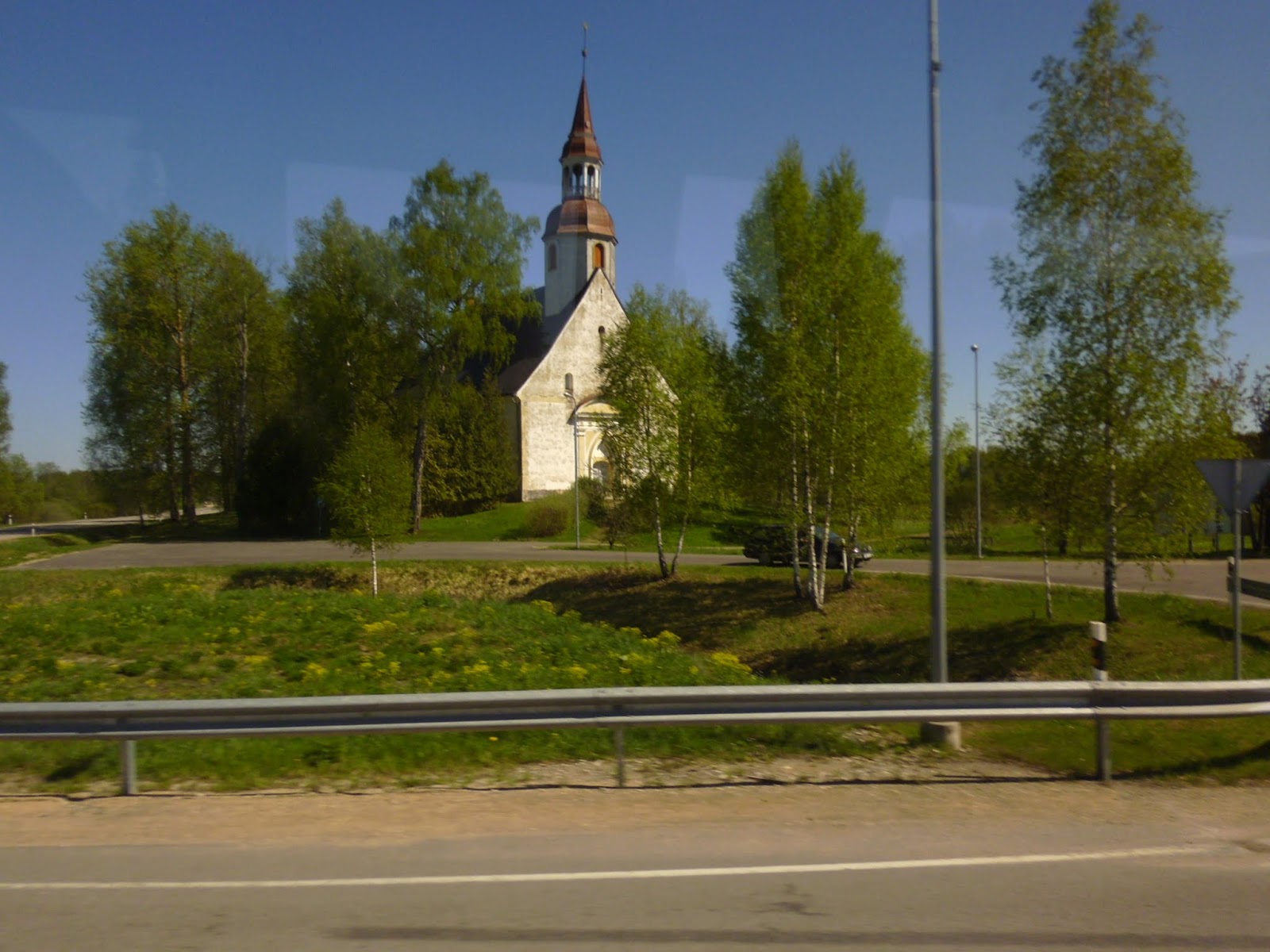
| On my journey home on the bus. A small taste of Estonia |
As I mentioned last week I was in Tartu for my studies. Monday I did a presentation, that I thought went well and the fact later on in the week I was asked to lecture to some MSc students seemed to confirm that. Unfortunately there was no way I could really go up just for one lecture this week, but I mentioned that I will not have any problems in the autumn semester and the lecturer who asked me was happy with that. I had a meeting with my supervisors on the Tuesday and finally managed to clarify what I'm doing now, so the study plan should be finished this week, rather late but since I don't seem to be doing anything normally then that is fine. Wednesday, I took THE exam! Statistics! I made some really stupid mistakes on the exam, but fortunately did enough to get through. I also finished the statistics assignment and I'm just waiting to see if that was enough to pass or not. To cap the week for my studies, I managed to book on for a conference in Italy and I booked the flights too. It all seems a bit surreal, one moment I'm planting seeds, helping with sorting wool from alpacas and the next planning to jet of to Italy for a conference.
 |
| Another view from the bus. It was a glorious day |
I sent off my passport this week to be renewed. It isn't due until December, but this is the time I will be doing least travelling and so needed to do it now. I was rather disgruntled though to find that even though it costs £72.50 in the UK, I have to pay £126 and a courier fee of £19.86. I am not sure why being outside the country should make a difference as it still has to go back to the UK to be processed. I can understand the extra courier fee but not the extra £53.50. I wonder how they manage to justify the extra expense? I kind of understood when it was processed abroad, but not now it is all sent to the UK anyway, it just seems very wrong.
 |
| On our way home from the land |
I was quite relieved to hear this week that the
EU can make sensible proposals if they want to. There was some concern that all seeds, regardless of origin would have to be subject to stringent standards. This could have affected small companies that sells seeds, the local seed swap or the larger seed swap organisations that aim to improve the availability of heritage seeds or open pollinated varieties. I realise that biosecurity is an issue, both from the harm that can happen when doling out diseased seed but also to unwanted additions to DNA. The fact is that it is not often that small swaps of seeds are going to lead to big problems with disease or large escapes of resistant crops, it is big business where that happens most often. In fact is is the small seed swappers who keep heirloom varieties or landrace varieties (plants specific to an area and well adapted to that area) alive, these are the sort of seeds that are dropped by large scale commercial growers. If we lose these small varieties we have an even bigger biosecurity problem because it reduces the gene pool we have access to whenever a disease threatens to wipe out certain types of plants or trees.
 |
More help needed. Can anyone identify these flowers for
us. It is a vine with lemony scented leaves. |